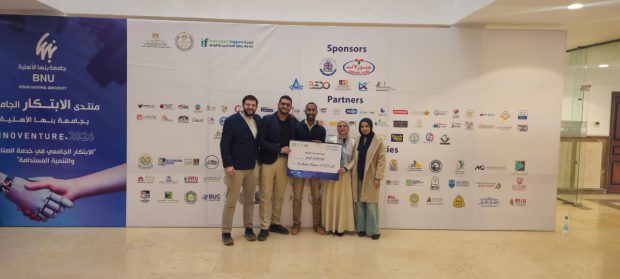
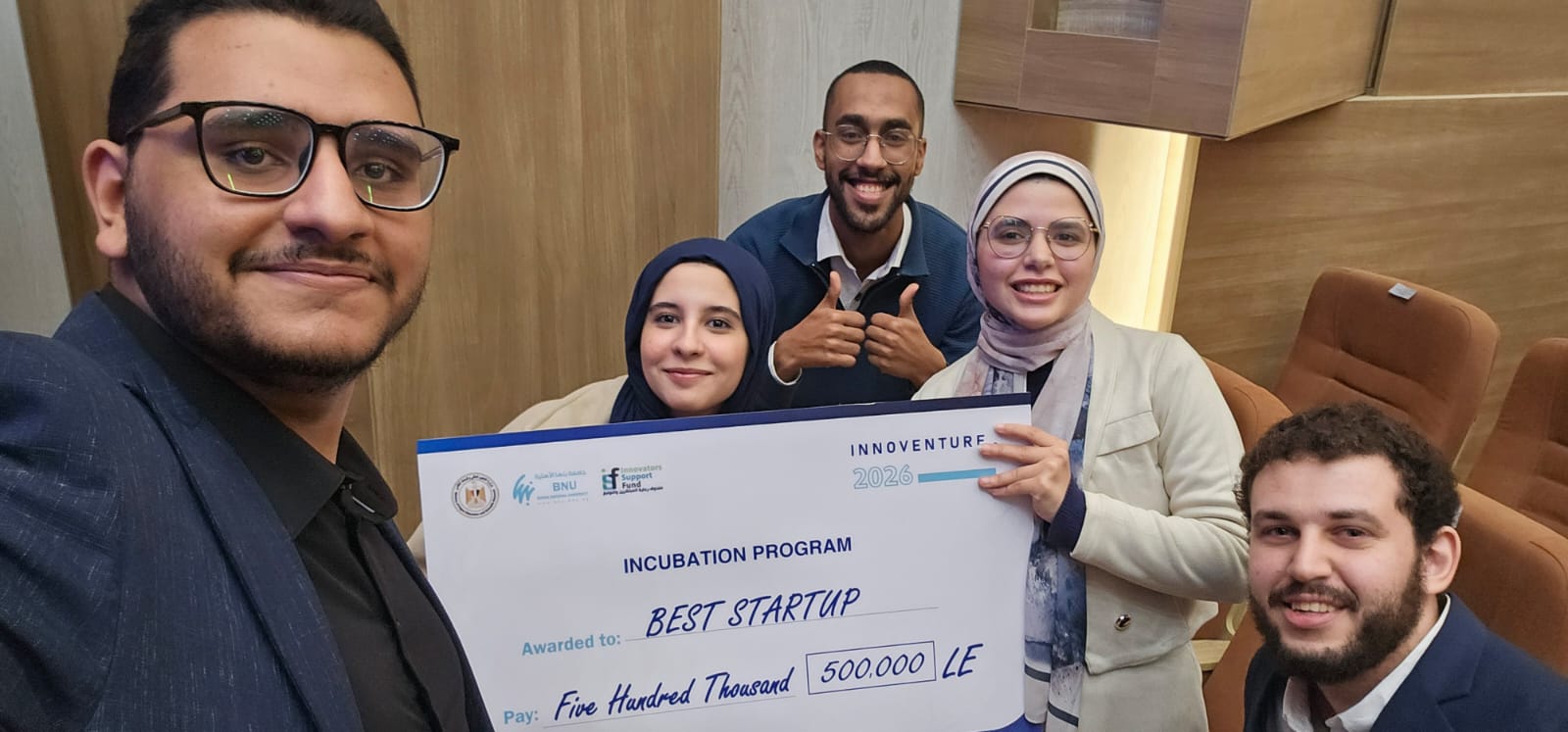
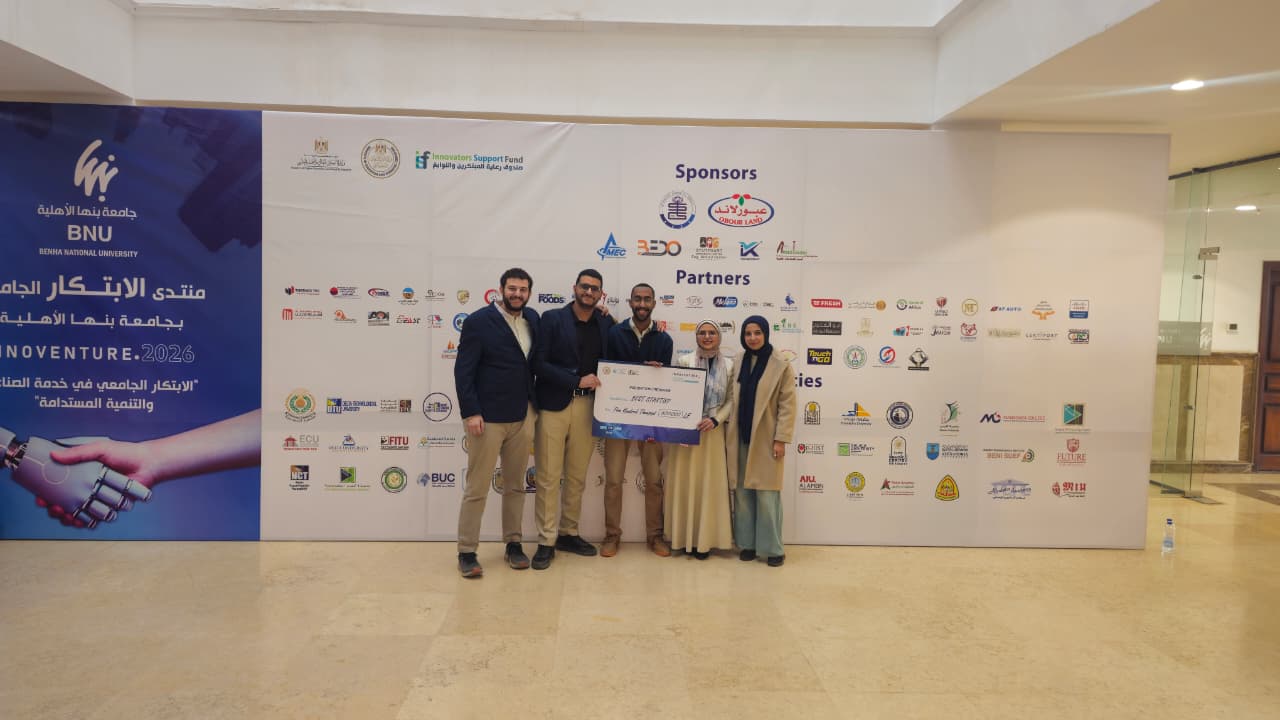
A team of final-year students from the Biomedical Engineering and Systems Department, Faculty of Engineering – Cairo University, consisting of students: Mostafa Ali, Ahmed Soliman, Ibrahim Fateen, Meram Hamid, and Shahd Ali, and supervised by Assistant Professor Dr. Meena M. Makary and Eng. Hossam Elrewaidy, PhD, Artificial Intelligence Engineer at GSK, has secured an incubation support grant worth EGP 500,000 for their graduation project CUBE.AI. The project was selected among only four winning projects nationwide, out of a total of 214 projects involving more than 1,000 students from 61 different institutions.

This achievement was announced at the conclusion of the INNOVENTURE 2026 University Innovation Forum, organized in collaboration between Banha National University and the Innovators and Talents Support Fund (ISF) of the Ministry of Higher Education and Scientific Research as a strategic partner, under the theme “University Innovation in Service of Industry and Sustainable Development.” The team successfully advanced through the competition stages, achieving first place in the Digital Transformation and Governance track, reaching the final shortlist of 22 teams, and subsequently participating in an intensive training bootcamp, demonstrating the project’s merit as an applied solution that connects scientific research with the requirements of sustainable development and Egypt Vision 2030.
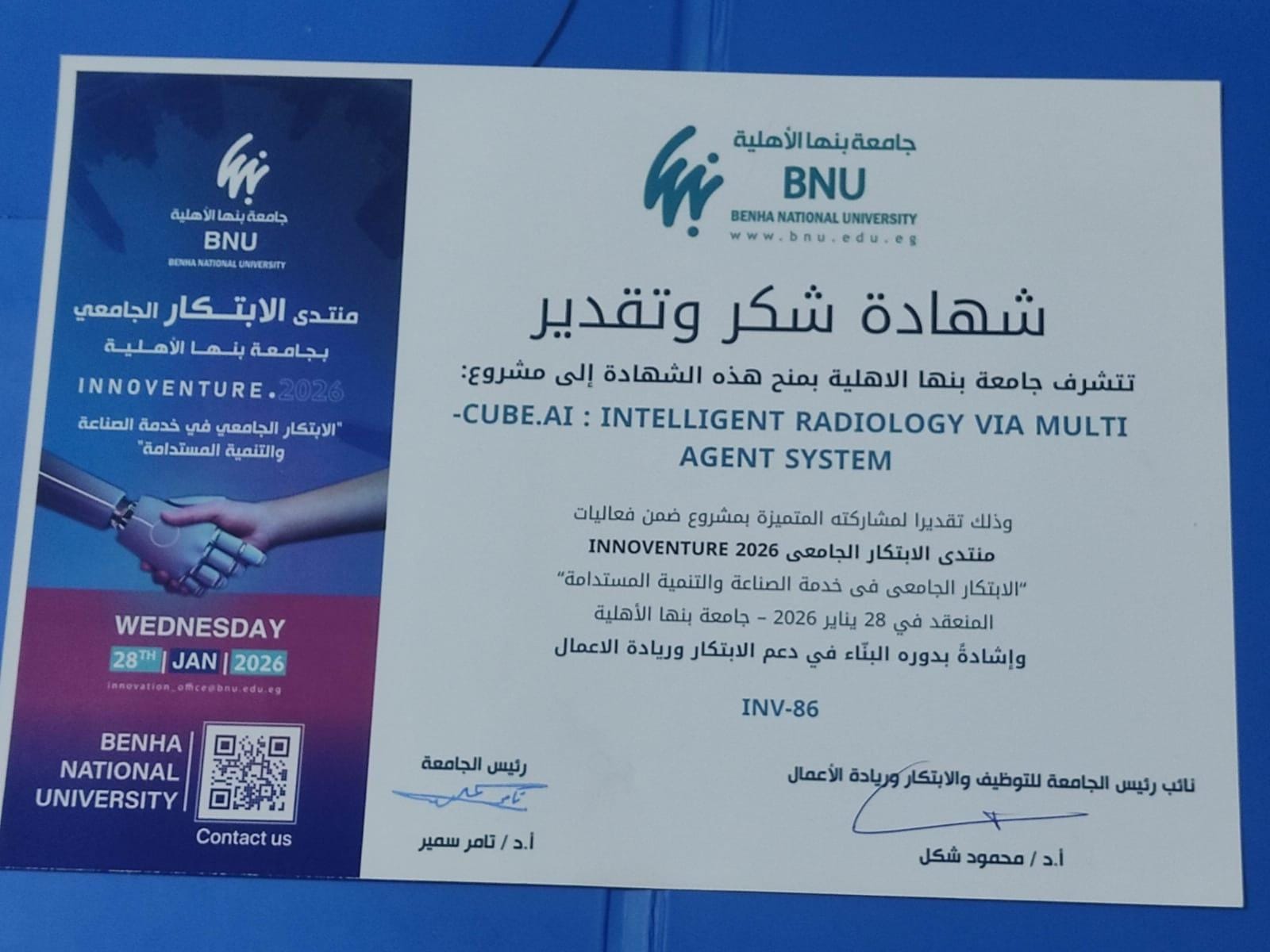
The CUBE.AI (Cairo University Biomedical Engineering AI) project represents a technological breakthrough fundamentally based on a Multi-Agent System, functioning as an integrated intelligent research team operating in the background to support physicians. The system does not merely provide tools; it automates the entire end-to-end research workflow, starting from planning and hypothesis formulation, through complex medical image segmentation stages that are accelerated with high precision using foundation models and assisted annotation tools, and culminating in artificial intelligence model training and result extraction. This intelligent architecture also aims to empower radiologists and researchers to build and deploy their own models (deployment) without requiring any programming expertise, reducing months of technical work into simple steps, accelerating scientific publication, and transforming research ideas into practical diagnostic solutions that serve the healthcare ecosystem.

Category: FacultyNews , GeneralNews , Slider , StudentNews